

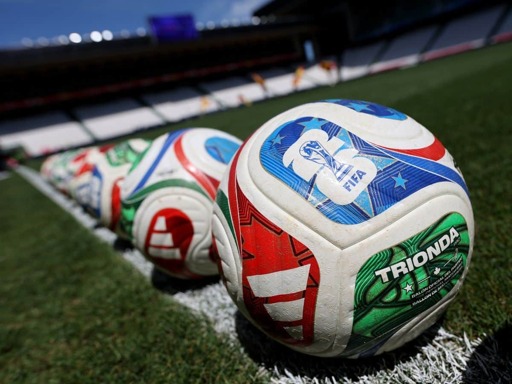

The World Cup ball is no longer just a piece of rubber and air, as fans have known it for decades, but has transformed in the 2026 World Cup into a comprehensive technological tool containing electronic sensors and advanced tracking systems, to the extent that it requires charging before matches.
The Spanish newspaper AS revealed that the new official match ball for the 2026 World Cup, named “Trionda,” contains a smart chip embedded within its structure, which necessitates pre-charging so it can transmit data during games.
The newspaper explained in its report that the battery works for several continuous hours, while the sensor remains extremely light so players do not feel its presence during play.
What is inside the World Cup ball?
According to FIFA, the International Federation of Association Football, the ball relies on “Connected Ball Technology,” a smart system that allows real-time tracking of every movement the ball makes on the field.
The “TRIONDA” contains a high-precision motion sensor that operates at a frequency of up to 500 times per second, allowing it to monitor the ball’s speed, direction, spin, and moment of touch with extreme accuracy.
This data is sent directly to the Video Assistant Referee (VAR) system to support refereeing decisions, particularly in cases of offside, handballs, and controversial calls.
What has changed compared to the 2022 World Cup?
One of the most notable developments in the 2026 edition concerns the method of fixing the sensor inside the ball.
In the 2022 Qatar World Cup, the sensor was fixed in the centre of the ball via an internal suspension system. In the 2026 edition, it has been integrated within one of the ball’s panels itself, a geometric change that reports described as a major step toward improving balance and stability during flight.
To compensate for this change, counterweights were distributed inside the other panels to maintain the ball’s stability during play, which some reports considered a shift from a “smart ball” to a “complete data system within the ball itself.”
How does the technology work during matches?
According to what AS newspaper and accompanying technical reports indicated, the ball’s data does not work separately but is integrated with a sophisticated camera system surrounding the stadium.
The system relies on 12 tracking cameras distributed inside the stadium, monitoring the locations of players and the ball, and analyzing movement at a rate of nearly 50 times per second.
The information is then sent directly to the VAR room, where it is used to determine: the moment the ball was passed, semi-automated offside situations, goal-line crossing, and certain handballs and precise contacts.
A ball that doubles as an “extra referee”
The most prominent paradox in the 2026 World Cup is that the ball itself has become part of the refereeing system.
While technology was previously limited to cameras and screens, the ball now transmits data directly to the referees, a scene that reflects the major transformation football is undergoing toward the world of artificial intelligence and real-time data analysis.
Featured image via Florencia Tan Jun/Getty Images
By Alaa Shamali
From Canary via This RSS Feed.