

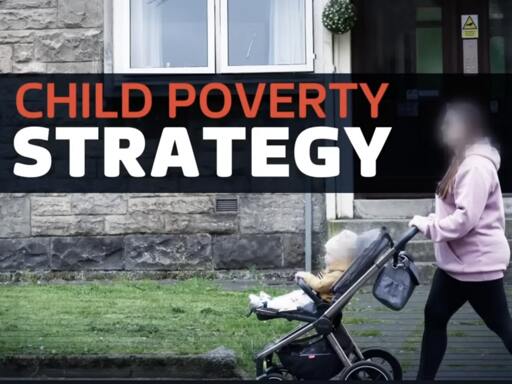
The government has finally released its Tackling Child Poverty strategy, which it claims will lift 550,000 children out of poverty by 2029. It comes as a record 4.45m children in the UK are living in poverty.
In total, the strategy will see the household incomes of 7.1m children increase, lifting 1.4m children out of “deep material poverty”. While these statistics paint a broad picture, they don’t really show the hell that poverty creates for children. And, poverty is not some kind of disease – it’s the consequence of successive governments abandoning working classes.
Child poverty strategy ‘a moral imperative’
The UK has a higher rate of child poverty than most comparable European Union countries. In total, 31% of UK children are in “relative low income”. This refers to people living in households with an income below 60% of the median in that year.
There are long-lasting implications to growing up in poverty – from being more likely to experience poor physical and mental health, to earning less than their peers and future homelessness.
For these reasons, the government is taking immediate action to remove the two-child universal credit limit. According to the report:
Around two million children will live in households that will see an increase in income as a result of removing the two child limit including 600,000 children in deep material poverty
Most families who will benefit from the removal of the limit are in employment.
Housing
One of the key points highlighted in the strategy is the number of children living in unsuitable housing and temporary accommodation. As of June 2025, over 172,000 children were living in temporary accommodation in England alone. This is more than twice as many as in 2010.
The first housing-related point in the strategy is:
Building more homes, and ensuring these are affordable, safe and decent
It goes on to say:
The government has committed to the biggest boost to social and affordable housing in a generation. We will work in partnership with the sector to rebuild their financial capacity to borrow and invest in new delivery alongside existing homes. The new ten-year, £39 billion Social and Affordable Homes Programme will kickstart social and affordable housebuilding at scale across the country
It specifically states that the government will work with partners to “update statutory guidance on social housing allocations”. This means that allocations will reflect “local needs” and effectively support people in vulnerable households – of course, this includes those with children in poverty.
Temporary accommodation
The next point linked to housing is:
Preventing homelessness and the use of emergency accommodation
It adds:
Children residing in temporary accommodation, particularly for long periods of time, should be recognised as experiencing one of the deepest forms of poverty. We will end the unlawful use of Bed and Breakfasts for families, improve the quality of temporary accommodation and take action to reduce the cost for councils.
It is well recorded that staying in temporary accommodation has a detrimental effect on children’s physical and mental health, along with their schooling. Of course, temporary accommodation is meant to be just that – temporary. But more and more, families are ending up staying long-term in what can only be described as hellish conditions.
Temporary accommodation has been recorded as a contributing factor in the deaths of at least 74 children since 2019. Of these, 54 were under the age of one.
Additionally, temporary accommodation is the most expensive form of housing, meaning it makes no sense for local authorities to be relying on it so heavily.
The strategy also states it will improve:
household experience and quality of temporary accommodation.
So Labour are clearly not planning to scrap temporary accommodation and the instability that comes with it altogether. Instead, they want to improve the experience families have whilst staying in it.
It explains:
In addition to ending the unlawful use of Bed and Breakfast for families, we will take action to improve the quality and the suitability of temporary accommodation placements, including action to prevent poor out of area placement practice. People living in temporary accommodation should expect strong protections against poor housing conditions and we are committed to improving standards across all types of housing, including temporary accommodation.
Limited supply
However, it’s worth noting that local authorities have a very limited supply of housing, and extremely limited budgets – meaning that this is probably very idealistic.
It then adds:
The government will introduce a temporary accommodation notification system, where local housing authorities would notify educational institutions, health visitors and GPs when a child is placed in temporary accommodation. This would enable health and education providers to respond appropriately to support children experiencing homelessness and mitigate the harmful impacts of living in temporary accommodation. This would also support schools and colleges to consider, where possible and applicable, providing pastoral support or practical assistance; for example, breakfast clubs, after school activities and support with homework.
As someone who has experienced homelessness – I personally think this is dangerous.
Even in 2025, homelessness comes with stigma and judgment. What educational institutions might think is “responding appropriately” could actually do more harm than good. A school or college might be the only place in which that child has a semblance of normality. No child needs the ‘homeless’ label on their record, even if it is temporary.
Not to mention the additional budgets the government would have to provide to actually implement this.
Scratching the surface
The strategy states that Labour is attempting to prevent homelessness by tackling its “root causes”. While the government is taking some positive measures to address this issue, such as the Renters’ Rights Act, there are other measures it could take that would dramatically reduce homelessness.
For example, increasing Local Housing Allowance (LHA) so that it aligns with local rents would go a long way. Consecutive governments have frozen the LHA for the majority of the last decade. Some areas, such as Hackney in London, have a £350 per month shortfall between LHA and local rents. Of course, this is driving more people into homelessness.
Responding to the publication of the Child Poverty Strategy, Amrik Arshi, Senior Economist in the Healthy Lives Team at the Health Foundation, said:
We welcome this long-awaited strategy, which outlines actions to boost family incomes, reduce the cost of essentials and begin to tackle the problem of too many children living in health-damaging temporary accommodation.
Tackling child poverty is a prescription for good health and reduced inequalities – with our health and wellbeing being built from our earliest years. The lifting of the two-child limit on Universal Credit was an important step to alleviate poverty now. But the strategy must deliver on a preventative approach that tackles the deep structural causes of poverty. Only then will we ensure that every child – now and in the future – has the opportunity to grow up with security and to thrive.
If Labour truly want to be preventative on poverty, they could start by making sure parents with dependents at risk of going hungry and homeless are given the support they need – instead of just being preached to about benefit scroungers.
Featured image via ITV News/ YouTube
By HG
From Canary via This RSS Feed.