

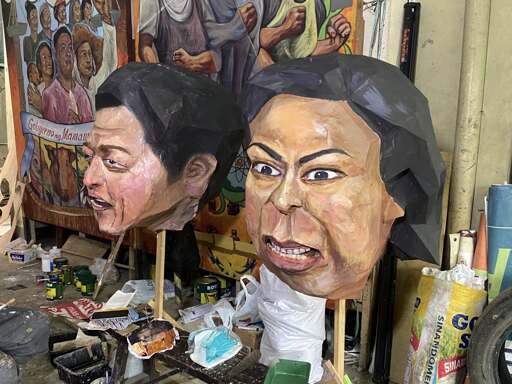
MANILA – Visual artist Anthony Jandusay of Surian ng Sining said that the effigy he is creating for International Human Rights Day on December 10 is a reflection of the widespread corruption and human rights violations.
“It all goes back to them,” he said, pointing to the caricatured faces of President Ferdinand Marcos Jr. and Vice President Sara Duterte.
In an interview with Bulatlat, Jandusay said that the effigy-making process takes 5 days to finish. This is a collaboration with human rights group Karapatan and cultural group Tambisan sa Sining.
The Philippines loses an estimated P700 billion (USD 11.7 billion) to P1.4 trillion (USD 23.5 billion) each year to corruption across all levels of government, according to the Philippine Institute for Development Studies (PIDS). These losses are due to various problems like rigged procurement, ghost projects, bribery, smuggling, and entrenched political patronage.
December 9 marks International Anti-Corruption Day and the anniversary of the United Nations Declaration on Human Rights Defenders. Ironically, Karapatan warned that the current government is intensifying attacks against rights defenders and anti-corruption advocates, placing the whole country in a “critical situation.”

Effigy concept | Photo by Dominic Gutoman/Bulatlat
“State-sponsored terror under Marcos Jr. continues to weaponize laws and fully mobilize the state’s armed forces to silence staunch defenders of people’s rights and anti-corruption advocates, to intimidate citizens and activists in protests, and to terrorize communities,” said Cristina Palabay, Karapatan secretary-general.
In the first major anti-corruption protest on September 21, the police arrested more than 200 individuals, including 91 children. First responder lawyers and human rights organizations documented cases of torture and ill-treatment suffered by the arrested protesters and bystanders.
It has become a case study in the international monitoring of CIVICUS, a global alliance of civil society organizations, dubbing the detention of protesters and activists as the most alarming trend across Asia Pacific this year.
“Governments are criminalising dissent on a massive scale. Peaceful protest is being painted as a crime, and those who dare to speak out and mobilise are paying with their freedom,” said Josef Benedict, CIVICUS Monitor’s Asia-Pacific researcher.
Palabay said that such criminalization remains a systematic and pervasive form of harassment designed to drain resources, restrict movement, and delegitimize the work of human rights defenders and their communities.
Those exposing corruption can get accused of engaging in terrorism and terrorist financing. At least 227 individual human rights defenders have already been charged and at least 30 of them are behind bars. Palabay said that they are trapped in prolonged legal battles, surveillance, and the burden of assets freeze.

Anthony Jandusay painting the effigy | Photo by Dominic Gutoman/Bulatlat
“The Anti-Terrorism Act has become a weapon for branding community organizers, humanitarian workers, and anti-corruption activists as enemies of the state. This is a direct assault on the rights guaranteed under the UN Declaration on Human Rights Defenders, and it must end, Palabay said.
The UN Declaration on Human Rights Defenders was adopted by consensus by the General Assembly in 1998. While not legally binding, the adoption signifies a commitment on its implementation which is to recognize human rights defenders and protect them.
Karapatan data showed that there are at least 14 enforced disappearances and 134 extrajudicial killings of human rights defenders, citing them as the gravest forms of attack against human rights defenders, during the administration of Marcos Jr., from July 2022 to November 2025.
“The deepening impunity fosters a culture not only of fear but of frustration, especially when perpetrators of human rights violations walk free, just like those involved in large-scale corruption and plunder in government,” Palabay said. “Defending rights is not a crime. Protest and dissent are justified and necessary in the face of repression, fascism, and the massive embezzlement of public funds.”
On International Human Rights Day, human rights defenders will take to the streets of Manila once again to demand justice and end corruption. Protest actions and similar activities are also expected in the key cities and provinces in the country. (RTS, DAA)
The post Marcos, Duterte face corruption, rights violations appeared first on Bulatlat.
From Bulatlat via This RSS Feed.