

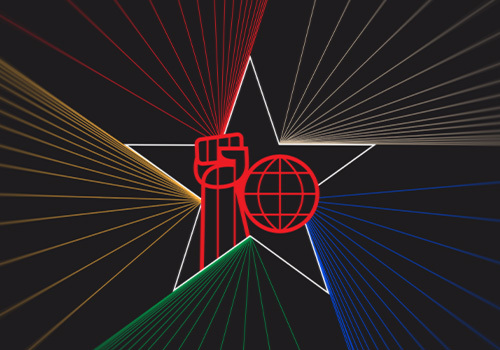
This dossier features a selection of posters from the Organisation of Solidarity with the Peoples of Asia, Africa, and Latin America (OSPAAAL), formed at the 1966 Tricontinental Conference in Havana, Cuba. In the decades that followed, OSPAAAL produced more than three hundred posters, which were folded into the pages of its magazine, Tricontinental, and sent across the world with a message of internationalism. We invite you to read more about OSPAAAL’s posters and their role in the battle of ideas in dossier no. 15, The Art of the Revolution Will Be Internationalist.

Lázaro Abreu Padrón (OSPAAAL), Sixth Anniversary of the Tricontinental Conference, 1972. Courtesy of The Radical Media Archive.
In 1966, the First Solidarity Conference of the Peoples of Africa, Asia, and Latin America – popularly known as the Tricontinental Conference – took place in Havana, Cuba. The conference, held sixty years ago, gives our institute its name. To commemorate the conference and its legacy, we have devoted dossier no. 95 to an assessment of the Tricontinental Spirit. This spirit is not manifest in the same way as it was in 1966, since the question of national liberation through armed struggle is not the focus of our time (although certain national liberation struggles in our time have armed retaliation imposed upon them). However, it is not the form but the substance of the Tricontinental Spirit that concerns us. Whereas the substance of the Bandung Spirit, which we wrote about in dossier no. 87 (April 2025), was an insistence on the ideals of sovereignty and multilateralism, this dossier argues that the substance of the Tricontinental Spirit is built around the ideals of human dignity and the class struggle.1 The Bandung Spirit and the Tricontinental Spirit were not contradictory in 1966, since Cuba – which hosted the Tricontinental Conference – was also a founding member of the Non-Aligned Movement (NAM) in 1961. The NAM, which Cuba hosted in 1979 and again in 2006, was the institutional embodiment of the Bandung Spirit. Today, sovereignty, multilateralism, dignity, and the class struggle shape the politics of large parts of the Global South – uniting these two spirits into one new mood.
How Young They Were
When Fidel Castro, the prime minister of Cuba and the first secretary of the Communist Party of Cuba, took the stage on the last day of the Tricontinental Conference on 15 January 1966, he was only 39 years old. The Cuban Revolution, which he led to victory in 1959 when he was 32, had just celebrated its seventh anniversary. His comrades, who drove into Havana after two years in the Sierra Maestra, were just as young, among them Camilo Cienfuegos (26), Che Guevara (30), Juan Almeida Bosque (31), Asela de los Santos Tamayo (37), and Celia Sánchez (38). By 1966, Castro already had a gravitas that manifested through the depth of his voice and the composure of his frame. He and his comrades had led the Cuban Revolution’s victory over the United States and its Central Intelligence Agency in the 1961 Bay of Pigs Invasion and Castro had personally foiled many assassination attempts. ‘Imperialism will inevitably be defeated’, he told the more than five hundred delegates that came from across Asia, Africa, and Latin America.2 No one in the room doubted him.
Many of the attendees of the Tricontinental Conference were at least as young as Fidel. Among them were Alice Badiangana (27) of the Congolese Youth Union (UCJ) and the African Women’s Union of the Congo (URFC) and Mário Pinto de Andrade (38) of the Popular Movement for the Liberation of Angola (MPLA). Amílcar Cabral of the African Party for the Independence of Guinea and Cape Verde (PAIGC) was 41, and Eduardo Mondlane of the Front for the Liberation of Mozambique (FRELIMO) was 45.3 These young people were at the helm of youthful organisations that had been forced into armed struggle by the brutality of Portuguese imperialism in Africa. They had tried the civil route, pleading for more rights both in Portugal and in Africa, only to be met with 8mm bullets from the Mauser 98k. This is why they laid down their law books and picked up AK-47s, which came to them from the Soviet Union and the People’s Republic of China. Imperialism was intolerable to these young people. They agreed with Castro’s assessment that imperialism would inevitably be defeated.
In Vietnam, the median age in the mid-1960s was between 18 and 20 years old – a result of the casualties incurred during its revolutionary war against an intractable foe (the French from 1946 and then the United States and its allies from 1955). By 1966, the country had lost at least one and a half million people to the violence – about 6% of the population.4 The Vietnamese representatives who came to Havana, too, were young, such as Nguyen Van Tien of the National Liberation Front of South Vietnam (Viet Cong), though his pseudonym makes it impossible to ascertain his exact age, and Tran Danh Tuyen, from the Democratic Republic of Vietnam, who was under forty. The youthful energy at the conference was palpable.
Enough!
Mehdi Ben Barka of the Moroccan National Union of Popular Forces (UNFP), then in his forties, spent over two years planning the Tricontinental Conference. On 30 September 1965, at a press conference in Havana during the early stages of preparation, he defined the Tricontinental as bringing together the two currents of world revolution: the current of the socialist revolution and that of national liberation.5 This was an accurate assessment of the politics of the Tricontinental Conference. It is what terrified the imperialist bloc.
But history does not move in a straight line. It has its twists and turns. On 29 October 1965, Ben Barka was ‘disappeared’ by shadowy forces in Paris (most likely French and Moroccan intelligence aided by the Israeli Mossad). Many others who did attend suffered the same fate – Mondlane was assassinated in 1969 and Cabral in 1973.
In the years after the conference, more openings for national liberation emerged, but the newly independent states were weakened by centuries of colonial rule and the drain of social wealth. In February 1966, just weeks after the conference, Western intelligence services egged on the Ghanaian military to overthrow Kwame Nkrumah, whose book Neo-colonialism: The Last Stage of Imperialism (1965) clearly laid out the structure that continued to suppress the ambitions articulated in Havana in 1966.6 The Tricontinental Conference lit a beacon for the world to see: We are here, those whom you have colonised. We will fight until our emancipation is complete, and that fight will bring socialism to the world. As Castro declared in his Second Declaration of Havana (1962): ‘This great humanity has said “Enough!” and has begun marching forward’. Though that beacon could not yet outshine imperialism, it would remain a guiding light for ongoing struggles across the Global South.

Rafael Morante Boyerizo (OSPAAAL), No to Militarism and Hunger, 1981. Courtesy of The Radical Media Archive.
Two, Three, Many Vietnams
Cuba sits less than 150 kilometres away from the United States. After it was seized from Spain in 1898, it became a playground for US elites. Under the thumb of New York financiers and Las Vegas gangsters, working-class Cubans endured wretched conditions over the next six decades. The revolution of 1959 was welcomed by most of the Cuban people, and they were not going to allow their gains to be reversed by the overthrow of their revolutionary government. Whatever privations the US would impose on Cuba, its people would remain resolute. This gave Fidel the confidence that Cuba’s adversary – imperialism – would suffer a total defeat.
Fidel stood at the podium of the Tricontinental Conference in his military fatigues, which he would wear until the end of his life. In The Wretched of the Earth (1961), Frantz Fanon mused about Fidel’s clothing:
Castro sitting in military uniform in the United Nations Organisation [UNO] does not scandalise the underdeveloped countries. What Castro demonstrates is the consciousness he has of the continuing existence of the rule of violence. The astonishing thing is that he did not come into the UNO with a machine gun; but if he had, would anyone have minded? All the jacqueries and desperate deeds, all those bands armed with cutlasses or axes find their nationality in the implacable struggle which opposes socialism and capitalism.7
Fidel and the Cubans were ever prepared for the ongoing hybrid war, blockade, economic warfare, and other forms of attacks that continue to this day.
On the last day of the Tricontinental Conference, Fidel asked: ‘Who taught us this lesson’ – that ‘imperialism will inevitably be defeated?’ Without missing a beat, he answered: ‘It has been taught to us by the peoples. Who among the peoples has given us in these times the most extraordinary lesson? The people of Vietnam’. Although the United States deployed its full arsenal, including aerial bombardment and chemical weapons in southern Vietnam, Fidel continued, ‘Yankee imperialists have been unable to crush the people in this part of Vietnam’.8
In the years before the Tricontinental Conference, Vietnamese revolutionaries took their fight directly to US targets in the South – including a US air base in Biên Hòa (1964) and Camp Holloway near Pleiku (1965). In response, Washington intensified its bombardment of the North, including Hanoi, while US troop levels climbed to nearly 200,000 by the end of 1965. The pressure on the Vietnamese Revolution was immense. Che Guevara’s ‘Message to the Tricontinental’, published in Tricontinental (the magazine of the Organisation in Solidarity with the Peoples of Asia, Africa and Latin America, OSPAAAL) in April 1967, called on revolutionary forces to ‘create two, three, many Vietnams’ – as he had hoped to do in the Congo and later in Bolivia, where he was murdered in October 1967.9 For Che, the hydra of revolution had to draw the US away from its focus on that edge of Asia.
Throughout the 1960s, the reverberations of anti-colonial struggles in places such as Vietnam and Algeria would erupt into student-led anti-war uprisings across the North Atlantic, driven equally by the civil rights struggles inside these states’ own borders. The slogans of the student movement were defined by anti-war and anti-racist sentiments. In France, the spark was the 1961 massacre of as many as 200 Algerians who were protesting the colonial war in North Africa. In the United States, anti-war students organised into the Students for a Democratic Society and galvanised popular sentiment against the war into a set of campaigns from 1965 onward. These efforts were shaped by the 1966 National Mobilisation Committee to End the War in Vietnam, which organised the 1967 March on the Pentagon and the 1968 protest at the Democratic National Convention in Chicago. Across Europe, the tenor in 1968 was against the involvement of these governments in colonial wars, especially the war on Vietnam. France’s 1968 began not at the Sorbonne but at Nanterre, where the members of the National Vietnam Committee were arrested on 22 March as they protested in front of an American Express office. This was the start of the Mouvement du 22 Mars (Movement of 22 March), which went from criticising the war to condemning the capitalist university and the capitalist system in general.10
Vietnam’s resolve and its eventual victory over imperialism inspired revolutionaries around the world, with Che’s call for ‘many Vietnams’ ringing in their ears. On the night of 31 December 1964, with images of the Cuban and Algerian revolutions and the Vietnamese struggle fresh in their minds, the Palestinian fedayeen (fighters) of Fatah, the main Palestinian nationalist movement, launched al-Asifa (The Storm), their first guerrilla operation against Israel. The fedayeen directly linked their struggle to Vietnam. Abu Jihad, who planned al-Asifa, travelled to Algeria, China, the Democratic People’s Republic of Korea, and Vietnam between 1963 and 1965.11 One of the fedayeen’s principal theorists, Ghassan Kanafani – who had travelled to China in 1965 and 1966 – wrote the Popular Front for the Liberation of Palestine’s major programmatic text, The Strategy for the Liberation of Palestine (1969), in direct conversation with the texts of the Vietnamese leader General Võ Nguyen Giap and of Mao Zedong.12 In the years after the conference, armed struggles broke out in India (Naxalbari, 1967), Iraq (1967–1968), Southern Africa (inaugurated by the Wankie Campaign of 1967), Malaysia (1968–1969), and Sri Lanka (1971). It is no wonder that the art of OSPAAAL, which was born at the 1966 conference, often featured images from the struggles in Palestine, South Africa, and Vietnam (as the art in this dossier illuminates).13 Films by Cuba’s Santiago Álvarez, such as Hanoi, martes 13 (1968) and 79 Primaveras (1969), documented the Vietnamese struggle and its connection to the world. The necessity for liberation struggles across the Third World provided the emotional glue for international solidarity.
The Tricontinental Conference’s general political declaration, read out by Maria Amelia Lopes Fonseca of the Movement of Portuguese Colonies, affirmed ‘the inalienable right of all peoples to full political independence and to resort to all forms of struggle that may be necessary, including armed struggle, to conquer their right’.14 Six years earlier, on 14 December 1960, the United Nations (UN) General Assembly passed Resolution 1514 on the Declaration on the Granting of Independence to Colonial Countries and Peoples, which noted ‘that the process of liberation is irresistible and irreversible and that, in order to avoid serious crises, an end must be put to colonialism and all practices of segregation and discrimination therewith’. The resolution further stated that ‘all armed actions or repressive measures of all kinds directed against dependent peoples shall cease in order to enable them to exercise peacefully and freely their right to complete independence, and the integrity of their national territory shall be respected’.15 The UN did not criticise armed struggle by occupied and colonised people. Instead, the resolution’s criticism of armed force was directed at the imperialists, whose violence imposed the path of armed struggle on the colonised. This was the experience of Cabral and the PAIGC, which was forced to take up arms because of the punitive Portuguese repression against their civil struggle. From the podium in Havana, Cabral told his fellow revolutionaries:
The past and present experiences of various peoples, the present situation of national liberation struggles in the world (especially in Vietnam, the Congo, and Zimbabwe) as well as the situation of permanent violence, or at least of contradictions and upheavals, in certain countries which have gained their independence by the so-called peaceful way, show us not only that compromises with imperialism do not work, but also that the normal way of national liberation, imposed on peoples by imperialist repression, is armed struggle.16
The keyword here is imposed. Armed struggle is not a choice, as Fanon argued in The Wretched of the Earth. This was the lesson learned by the assassination of Patrice Lumumba on 17 January 1961, just a month after UN Resolution 1514, when the attempt at a peaceful struggle for Congo’s freedom was stopped by the imposition of violence by imperialism.

Lázaro Abreu Padrón (OSPAAAL), Day of Solidarity with Zimbabwe, 1972. Courtesy of The Radical Media Archive.
Zigs and Zags
Vietnam, Palestine, Guatemala, the Congo, Zimbabwe – these, and many others, were the contours of the Tricontinental Spirit. The era of the Tricontinental Spirit began with the victory of the Cuban Revolution in the morning of the new year of 1959 and was partly defined over the next two decades by a range of revolutionary victories: Ethiopia (1974), Vietnam (1975), Laos (1975), Guinea-Bissau and Cape Verde (1974–1975), Mozambique (1975), São Tomé and Príncipe (1975), Angola (1975), Afghanistan (1978), Grenada (1979), Nicaragua (1979), and Zimbabwe (1980). Communist revolutionaries and national liberation forces fought protracted battles – such as in Vietnam and Nicaragua – or else found themselves in a position of strength when the state system collapsed after a political crisis and opened the door to their victory, as in Ethiopia and Grenada. What united these forces was the desire for complete independence and sovereignty – as UN Resolution 1514 put it – alongside varying levels of commitment to socialist revolution in each context. In other places, such as Palestine, South Africa, and Western Sahara, the process of liberation was blocked during this period. Yet, whether in victorious or still-subjugated territories, the energy of these national liberation movements gathered force in the halls of the UN, leading in 1974 to the passage of UN General Assembly Resolution 3201 on the New International Economic Order (NIEO), a vision for a more humane present.
Most of these revolutionary breakthroughs would not be allowed to breathe. In 1979 the US began Operation Cyclone to fund the Mujahideen and paralyse the communist government in Kabul. In the early 1980s, Washington mined Managua harbour and funded the Contras, Nicaragua’s variant of the Mujahideen, to suffocate the Sandinista government. Fidel and his comrades at the 1966 conference were well aware of the policy of asphyxiation pursued by the imperialist powers. In Havana, they discussed the archipelago of military bases retained by the old colonial powers – from Britain’s base in Diego Garcia to France’s base in Dakar – and by the strongest imperialist power, the United States, which would eventually create nine hundred military bases in many countries around the world.17 Though imperialist threats against Cuba were unsuccessful, imperialist coups in a range of countries hampered the advance of humanity. The coups in the Congo (1961), Brazil (1964), Indonesia (1965), and Ghana (1966) destroyed the left in these key countries for at least a generation, creating a blueprint for coups against national liberation movements that was carried out across the Third World. Nevertheless, in 1978, US National Security Advisor Zbigniew Brzezinski wrote a critical evaluation of the limits of US power in a secret memorandum to President Jimmy Carter:
The United States was badly out of tune with the Third World, with little awareness of the need for economic, political, and social change or sympathy for ideological diversity. There was overemphasis on realpolitik and an exaggerated preoccupation with the Soviet threat. Through the Third World, there was a pervasive feeling of anti-Americanism.18
Despite the dampening of the insurgencies and the Tricontinental Spirit, it was clear that there was a rising tide against the United States. Though this tide did not have the strength to overcome the neocolonial structure set in place after 1945, it remained present. For a time, US-backed covert wars and coups swept Central and South America as well as South Asia (notably in Pakistan in 1977). The 1979 Iranian Revolution would disturb this apparent stability for decades to come, but otherwise the US felt that it had effectively managed the Tricontinental Spirit despite the lingering anti-Americanism.
The Bandung Spirit Returns
The arrogance of the US-led imperialist bloc only grew after 1991 with the disintegration of the Soviet Union and the Eastern European communist state system and the weakening of the Third World Project by a persistent debt crisis. The US imperiously sought to build a unipolar world which could contain its own contradictions. It was one thing to destroy Yugoslavia (1999) and create the World Trade Organisation (1995), the two legs of war and trade, but it was another to vanquish humanity’s dreams of emancipation. Even at the peak of this unipolar order, a breakthrough came in Venezuela in 1998 when the Bolivarian Revolution rose to power, led by Hugo Chávez. The US overreached by trying to fight a poorly defined Global War on Terror while hollowing out its own industrial capacity to construct a globalised chain of accumulation that advantaged private capital. The wars, de-industrialisation, financialisation, and the lack of net fixed capital investment led to an astronomical increase in social inequality in the Global North, which cascaded into political polarisation and a crisis of legitimacy. Ignoring the crisis within their countries, the North Atlantic Treaty Organisation (NATO) and the US military began to put pressure on what they saw as the two remaining serious obstacles to Western power in the new era: China and Russia. The United States unilaterally began to break down the global arms control regime, withdrawing from the Anti-Ballistic Missile Treaty in 2002 and the Intermediate-Range Nuclear Forces Treaty in 2019. It intervened in the domestic affairs of Ukraine in 2014 and closed a major arms deal with Taiwan in 2015. While the balance of forces had prevailed against Yugoslavia in 1999, the global situation had begun to shift and neither Russia nor China would allow the Global North to extend its military reach to their borders.
What had appeared to be the dying embers of the Bandung Spirit were fanned back to life in this period as the term ‘Global South’ appeared in the high-level state discussions between countries of Africa, Asia, and Latin America. Senior leaders spoke of ‘South-South Cooperation’, a phrase that had previously only appeared in minor UN reports and in gatherings to commemorate the heritage of the Third World. By BRICS V, held in Durban, South Africa, in 2013, the issue of the role of the Global South in strengthening multilateralism had returned and would only strengthen in the decade to come. This was largely, although not fully, recognised in most discussions as the result of the re-emergence of China and Russia onto the world stage. China’s industrialisation allowed it to build up large trade surpluses which it recycled into the Belt and Road Initiative and its pledge to industrialise Africa. Russia recovered some of its heavy industry from the oligarchy and used those assets to rebuild its state infrastructure, including the military. Sanctioned by the West, China and Russia settled their border dispute and increased their trade, leading to a ‘no limits’ partnership agreement in 2022. Chinese and Russian leadership in the BRICS process and in other South-South processes has helped stir the Bandung Spirit in the Global South once more. At XVII BRICS, held in Rio de Janeiro in 2025, Brazil’s President Lula da Silva said that ‘BRICS is the manifestation of the Bandung Non-Aligned Movement. BRICS keeps the Bandung Spirit alive’.19 But is the Bandung Spirit the same as the Tricontinental Spirit?

Unknown artist (OSPAAAL), Week of Solidarity with the Peoples of Asia, 1968. Courtesy of The Radical Media Archive.
The Tricontinental Spirit
Over the past two years, Tricontinental: Institute for Social Research has emphasised the importance of two related concepts: sovereignty and dignity.20 It can be said that sovereignty, together with multilateralism, is the central ideal of the Bandung Spirit, whereas dignity, grounded in the class struggle, is the defining category of the Tricontinental Spirit.
Both the Bandung Conference (1955) and the founding of the Non-Aligned Movement (1961), referenced by Lula, were gatherings of heads of state and were therefore inter-state meetings. The broad front at Bandung and NAM meetings came together around the concept of sovereignty: the idea that a state must have sovereign control of its territory, be allowed to dispense with its raw materials, and be permitted to manage its internal affairs in its own fashion based on its cultural and political development. But sovereignty is a limited concept. In international law, for instance, sovereignty is largely reduced to a negative principle of non-interference in the internal affairs of a state (as in Article 2 of the UN Charter of 1945), which in popular terms amounts to ‘no foreign intervention’. Yet the concept of sovereignty remains a radical proposition because of the Global North’s control over international institutions and its political and military interventions in the Global South. It provided the foundation for a broad anti-imperialist alliance that would fight to create multilateralism and democratise the international order. However, sovereignty, by itself, does not guarantee the end of exploitation of human by human – it can only dilute the violence of imperialism.
The concept of sovereignty is not only limited but also anachronistic. It reflects an inter-state dynamic that emerged in the pre-modern era, when states crafted various mechanisms to avoid unwinnable inter-state conflicts. Several pre-modern treaties and alliances began to establish the idea of sovereignty in an age before it was acknowledged that all people are to be treated as fundamentally equal. Some examples include:
- The Mande Charter at the founding of the Mali Empire (1235).
- The Aztec Triple Alliance, which brought together the peoples of Tenochtitlan, Texcoco, and Tlacopan (1428).
- The formation of the Iroquois Confederacy (1400–1450).
- The Peace of Westphalia, which ended the Thirty Years’ War and the Eighty Years’ War in Europe (1648).
- The Treaty of Nerchinsk, which ended the conflict between Qing China and Tsarist Russia (1689).
- The establishment of the Ashanti Confederacy (1701).
While each of these formations developed the idea of sovereignty, they did so merely to protect the peace between states. These ideas would eventually be codified in the writings of French jurist Jean Bodin (1530–1596) and Dutch philosopher Hugo Grotius (1583–1645), whose work formed the ideology of the Congress of Vienna (1814–1815) and the basis of modern North Atlantic political science. Bodin and Grotius did not know about the Mande Charter or the Aztec Triple Alliance, but the ideas they developed – such as those set out by Grotius in On the Law of War and Peace (1625) – would have resonated with the Malians and the Aztecs. These were straightforward ideas about non-interference in the affairs of a neighbouring state. They were articulated by a range of contemporaries, such as the Mughal intellectual Abu’l Fazl (1551–1602) in his Akbarnama (1596), whose concept of sulh-i Kul (peace with all) could be fruitfully compared with the writings of Grotius. However, these pre-modern thinkers did not extend beyond inter-state amity. There was no purpose to this non-interference beyond the desire to avoid endless warfare and domination.
In the modern era, however, when the idea of human dignity shapes the discourses of freedom, equality, and social rights, it is not enough to prevent wars and destruction. There must be a positive articulation of states’ obligation not only to provide security for their inhabitants but also to improve their lives in material and cultural terms. This is the outcome of various mass rebellions, from the French and Haitian revolutions (1789 and 1804), through the Paris Commune (1871) and the October Revolution (1917), to the Chinese and Cuban revolutions (1949 and 1959). This is the unity, as Ben Barka said, of the two currents of national liberation and socialist revolution. The expectation set in place by these cascading revolutions is that human life must be improved beyond the miseries of the past and that control over material advances must be democratised among the masses. In other words, states must be obliged to strive for the full dignity of their citizens, and indeed – through concepts such as internationalism – of all peoples in the world. With dignity emerging as a key concept, as enshrined in the 1948 Universal Declaration of Human Rights, the Westphalian idea of sovereignty as the founding concept of inter-state relations had to be updated. It was insufficient to prevent war and foreign interference. It was necessary to improve the material conditions of humanity.
The Tricontinental Conference of 1966 absorbed the Bandung Spirit and sought to radicalise it. A state can claim sovereignty over its territory, even expel foreign capital, and nonetheless fail to uphold the dignity of its people by allowing domestic capital to continue to exploit them. The Bandung Spirit, in other words, is limited to national independence and does not deepen the idea of emancipation to include freedom from the basic atrocities of capitalism. The Tricontinental Spirit, on the other hand, fights to democratise the world order and argues that this battle must work alongside the struggle to democratise national liberation projects. It acknowledges the importance of the broad front to establish multilateralism but goes further than this, recognising the necessity of the class struggle and socialism. Our struggles for socialism – linked directly to the Tricontinental Conference and its era – emerge not as an ideal to be established in the world, but out of the real movement which seeks to abolish the present state of things.21 That insight, and the mood captured within it, remains as true today as it was when it resonated with Cabral and Castro in the 1960s. Our movement is not born out of a choice. It is a necessity.
While the Bandung Spirit forecasts the future deed of emancipation through the fight for national sovereignty, the Tricontinental Spirit calls on us to democratise and radicalise the projects of human emancipation that social movements are already building today. Our quest requires that such principles not remain mere ideas; they must become vital and real in the world. Emancipation – literally to ‘take out of the hand’ – means prising human beings from the grip of oppression.

Alberto Blanco González (OSPAAAL), Namibia: Power to the People, 1981. Courtesy of The Radical Media Archive.
Notes
1Tricontinental: Institute for Social Research, The Bandung Spirit, dossier no. 87, 8 April 2025, https://thetricontinental.org/dossier-the-bandung-spirit/.
2Tricontinental, Havana 1966: Documents of the First Solidarity Conference of the Peoples of Africa, Asia and Latin America, ed. Manolo De Los Santos (New York: 1804, 2026).
3Tricontinental: Institute for Social Research, The PAIGC’s Political Education for Liberation in Guinea-Bissau, 1963–74, 1 July 2022, https://thetricontinental.org/studies-1-national-liberation-paigc-education/.
4Charles Hirschman, Samuel Preston, and Vu Manh Loi, ‘Vietnamese Casualties During the American War: A New Estimate’, Population and Development Review, vol. 21, no. 4, December 1995.
5Prensa Latina, Granma, 3 October 1965. For more of his important work, see Écrits politiques (1948-1965), ed. Bachir Ben Barka (Paris: Syllepse, 2021).
6Kwame Nkrumah, Neo-Colonialism: The Last Stage of Imperialism (London: Panaf, 2009).
7Frantz Fanon, The Wretched of the Earth (Harmondsworth: Penguin Books, 1967), 61–62.
8Vijay Prashad, ‘Foreword’, in Tricontinental, Havana 1966: Documents of the First Solidarity Conference of the Peoples of Africa, Asia and Latin America, xix.
9Ernesto ‘Che’ Guevara, On Socialism and Internationalism (New Delhi: LeftWord Books, 2020).
10There is a vast scholarship on this theme. For an introduction, see Christoph Kalter, The Discovery of the Third World: Decolonization and the Rise of the New Left in France, c.1950–1976 (Cambridge: Cambridge University Press, 2016).
11Ziad Mahmoud Abu Amr, Khalil al-Wazir (Cairo: Dar al-Shorouk, 2013).
12‘Excerpts from PFLP Strategy for the Liberation of Palestine (1969)’, Ghassan Kanafani: Political Writings, eds. Louis Brehony and Tahrir Hamdi (London: Pluto Books, 2024).
13Tricontinental: Institute for Social Research, The Art of the Revolution Will Be Internationalist, dossier no. 15, 8 April 2019, https://thetricontinental.org/the-art-of-the-revolution-will-be-internationalist/.
14Tricontinental, Havana 1966: Documents of the First Solidarity Conference of the Peoples of Africa, Asia and Latin America.
15United Nations General Assembly, ‘Declaration on the Granting of Independence to Colonial Countries and Peoples’, resolution 1514 (XV), 14 December 1960, Office of the United Nations High Commissioner for Human Rights, https://www.ohchr.org/en/instruments-mechanisms/instruments/declaration-granting-independence-colonial-countries-and-peoples.
16Tricontinental, Havana 1966: Documents of the First Solidarity Conference of the Peoples of Africa, Asia and Latin America.
17Tricontinental: Institute for Social Research, Hyper-Imperialism: A Dangerous Decadent New Stage, contemporary dilemmas no. 4, 23 January 23, https://thetricontinental.org/studies-on-contemporary-dilemmas-4-hyper-imperialism/.
18‘NSC Report for 1977: A Critical Self-Appraisal. Memorandum From the President’s Assistant for National Security Affairs (Brzezinski) to President Carter, Washington, 12 January 1978’, in Foreign Relations of the United States, 1977–1980, vol. 1 (Washington: United States Government Printing Office, 2014).
19Lula abre Cúpula do BRICS com apelo por invesrimentos para a paz e seguranca’ [Lula Opens the BRICS Summit With a Call for Investments for Peace and Security], BRICS Brasil, 2025, https://brics.br/pt-br/noticias/lula-abre-cupula-do-brics-com-apelo-por-investimentos-para-a-paz-e-seguranca.
20Tricontinental: Institute for Social Research, Sovereignty, Dignity, and Regionalism in the New International Order, dossier no. 62, 14 March 2023, https://thetricontinental.org/dossier-regionalism-new-international-order/.
21Karl Marx and Friedrich Engels, The German Ideology (Moscow: Progress Publishers, 1976).
From | Tricontinental: Institute for Social Research via This RSS Feed.